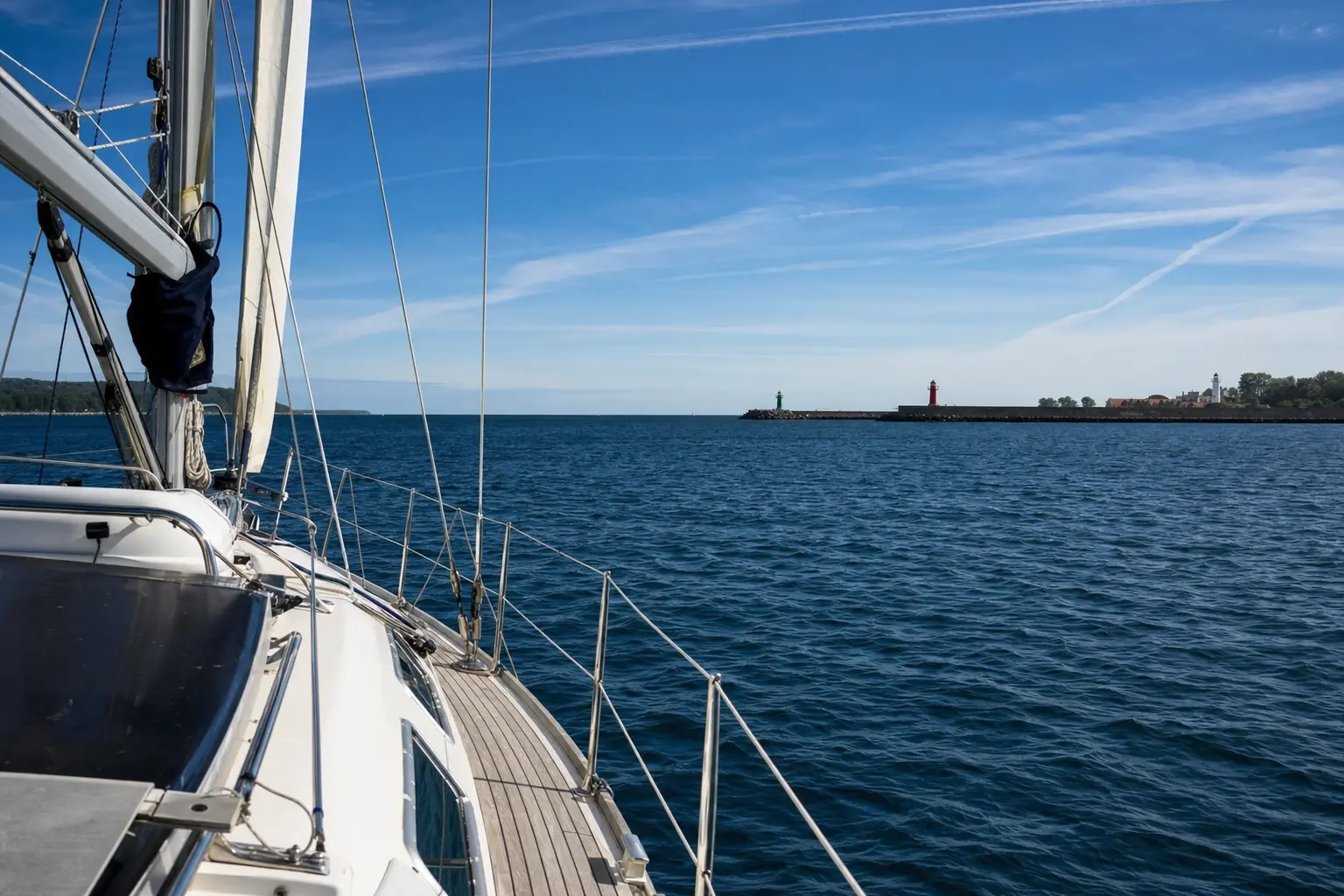
For sailors raised on big tides and ocean swells, the Baltic can seem, at first glance, almost gentle. That is a mistake. This brackish, semi-enclosed sea, linked to the North Sea by the Danish straits, has relatively modest tides in many cruising areas, but it is never simple. Wind can raise a short, steep chop. Water levels can shift under prolonged pressure. Channels can be narrow, harbors shallow and rocks unforgiving.
Yet Baltic Sea sailing is one of Europe’s great cruising experiences precisely because it asks for attention. The distances are humane. The ports are rich in history. A week can carry a crew from Danish island villages to German Hanseatic towns; a longer voyage can stretch toward Sweden’s granite archipelagos or Poland’s broad beaches and rebuilt maritime cities.
"The Baltic is not a sea that overwhelms. It is a sea that teaches you to notice."
Why the Baltic feels different
The Baltic is young in geological terms and unusually low in salinity because many rivers feed it while its connection to the Atlantic is limited. That brackish character affects marine life, corrosion patterns and even the feel of a swim on a warm July afternoon. For sailors, the more obvious difference is tidal. In much of the Baltic, tidal range is small compared with the English Channel or Atlantic Europe, so passage planning tends to focus less on tidal gates and more on wind direction, water depth, traffic and daylight.
That does not mean a skipper can ignore water levels. Strong winds can push water into bays or pull it away from shoal approaches. In the western Baltic, where Denmark, Germany and Sweden form a busy maritime triangle, forecasts deserve close reading. The best crews treat the Baltic as coastal cruising with offshore habits: good navigation, conservative reefing and a plan B before the harbor entrance appears.
Denmark: islands, straits and civilized short hops
Denmark may be the most elegant introduction to Baltic cruising. The South Funen Archipelago, the Little Belt, the Great Belt and the Øresund offer a web of protected routes where island harbors are often a morning sail apart. Towns such as Svendborg, Ærøskøbing and Marstal have long maritime memories, with boatyards, ferries and wooden craft still shaping the waterfront mood.
For visiting yachts, Denmark’s appeal is not only scenery but rhythm. The passages encourage unhurried seamanship. A crew can leave after breakfast, reef early if the forecast hardens, and still arrive with time to walk cobbled streets or buy smoked fish. The challenge is traffic and geography. Ferries move fast, commercial routes are busy, and the passages between islands can accelerate wind. The chart may look sheltered; the cockpit may tell another story.
Germany: Hanseatic history and practical seamanship
Germany’s Baltic coast is less internationally mythologized than Denmark’s, but it is a serious cruising ground. Kiel is a natural hub, not least because the Kiel Canal, known in German as the Nord-Ostsee-Kanal, links the North Sea and the Baltic and remains one of Europe’s busiest artificial waterways. Eastward, Lübeck, Wismar, Stralsund and Greifswald carry the imprint of the Hanseatic League, the medieval trading network that helped define northern Europe’s commercial culture.
The German coast rewards careful pilotage. Rügen, Hiddensee and the Bodden waters offer beauty and shelter, but also shoals, marked channels and places where a casual shortcut can become an expensive mistake. This is where Baltic cruising becomes almost architectural: buoys, lights, church towers, leading lines and bridge openings arrange themselves into a navigational puzzle. It is satisfying sailing, but it is not lazy sailing.
Sweden: rock, pine and the art of precision
Sweden changes the texture of the voyage. From Skåne in the south to the great archipelagos farther north, the coast introduces a harder, older landscape: granite, pine, skerries and narrow cuts where the water may be deep close to stone. Many sailors dream of the Stockholm Archipelago, but even southern Swedish ports such as Ystad, Karlskrona and Kalmar can provide a powerful taste of the country’s maritime character.
The Swedish lesson is precision. Charts and electronic navigation are excellent tools, but they are not a substitute for watchkeeping. Rocks can sit exactly where a tired helmsman would like to turn. Mooring practices may also differ from what visitors know at home, including stern buoys or tying close to natural rock in some areas. Done well, it is magical: the boat still, the forest close, the evening light lingering far later than expected in midsummer.
Poland: beaches, shipyards and a coast coming into its own
Poland’s Baltic coast is sometimes treated as the edge of a cruise rather than a destination. That underestimates it. From Świnoujście near the German border to Kołobrzeg, Gdynia and Gdańsk, the Polish coast combines long sandy shores with cities deeply tied to European history. Gdańsk is especially resonant: a port shaped by trade, war, reconstruction and the Solidarity movement, which began in the shipyards and helped change the politics of a continent.
For sailors, Poland can feel more exposed than the island-sheltered cruising of Denmark. Harbors may be farther apart, and a northerly blow can make entrances uncomfortable. But the rewards are substantial: modern marinas, working waterfronts, seafood, beaches and the feeling of sailing along a coast that is both old and newly confident. The Hel Peninsula, curling into the Gulf of Gdańsk, is one of the Baltic’s memorable geographic signatures.
Weather, season and the skipper’s judgment
The most forgiving season is generally late May through September, with July and August bringing the warmest weather and busiest harbors. Spring can be bright but cold; autumn can be beautiful and brisk. Even in summer, a cockpit jacket and cabin heat are not luxuries. The Baltic’s short chop can be tiring, especially when wind opposes the general line of travel.
A sensible yacht for the region does not need to be enormous. It does need reliable engine power, sound ground tackle, updated charts, good lights, AIS if possible and a crew willing to slow down. Because many passages are short, the temptation is to keep moving. The wiser approach is to build spare days into the plan. In the Baltic, waiting out a blow is not failure. It is seamanship.
The voyage worth taking
The best Baltic itinerary is not a checklist of flags. It is a sequence of contrasts: Denmark’s island intimacy, Germany’s disciplined channels and brick harbors, Sweden’s rocky precision, Poland’s open coast and historic ports. Sailors who come expecting Mediterranean ease may find the water cooler, the skies moodier and the navigation more exacting. Those who come curious will find something rarer: a sea where geography, history and weather still speak in equal measure.
That is the Baltic’s quiet bargain. It gives you short passages, but not shortcuts. It offers safety, but asks for respect. It looks modest on the map, tucked into northern Europe, yet it can fill a lifetime of cruising with questions worth answering one harbor at a time.